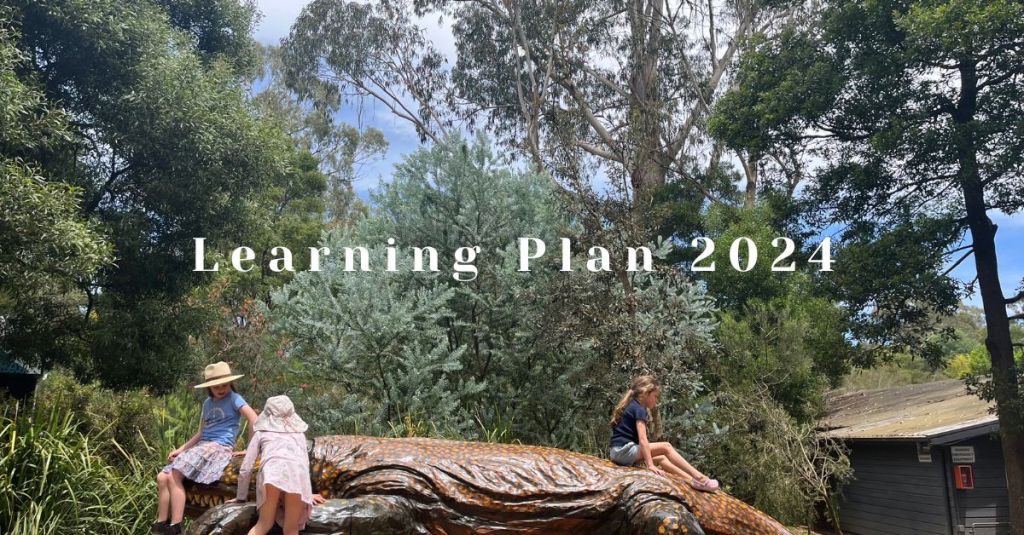
You’ll see here below, our children’s 2 Learning Plans that went along with the Homeschooling Registration Application are quite different. I feel it’s a great example of how 2 differing plans can serve the same values. I feel it also shows how home education can evolve after a few years in one family. This is how our journey has evolved.
As the homeschooling world has enveloped me out of sheer passion (for lack of a better word), I feel these changes have been informed by my extensive reading and research around human development (spiritual, mental, physical ~holistically speaking). This is where we are at in terms of how we feel we can best serve our children’s education.
For our second daughter, the Learning Plan looks like this, which is how our eldest daughter, 10 this year, is currently doing her studies with great enthusiasm. So… it’s what we feel works well for us so far, in this point in time. I shall make further comments after I paste the content of the plan below it’s introduction screenshot, so read on for more.
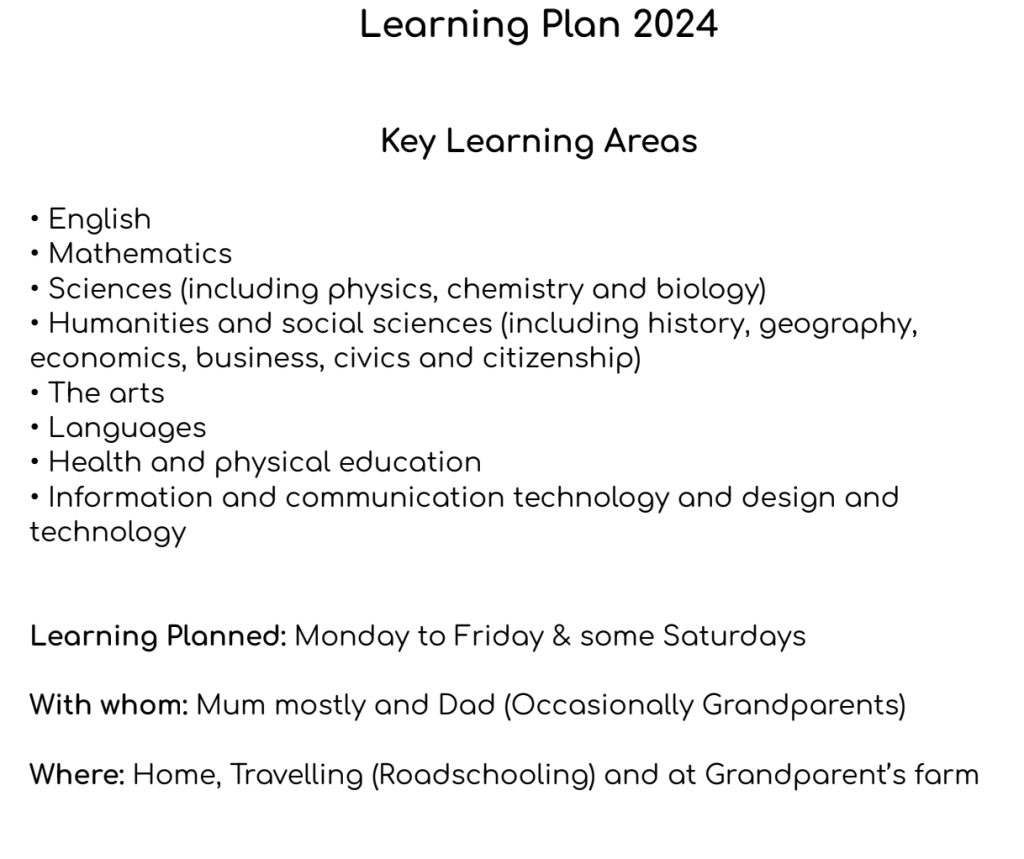
1 • English
● Currently investing time in using The Good and the Beautiful
Language Arts / Literature (Curriculum).
● Using Reader books daily for 30 – 60 minutes with family read
aloud books.
● 1 Lesson per day (5-6 days per most weeks)
● Duration 30 – 60 minutes
● Copious amounts of reading from every available source – often
from our own extensive home library, often from local libraries.
Resources: The Good and the Beautiful Language Arts workbooks,
Steiner Curriculum & home library, Classical story books, Your Natural Learner book recommendations, home library, local Library, Daily Read
aloud time, regular writing practice.
2 • Mathematics
● Currently using The Good and the Beautiful Maths Curriculum as
a resource guide. (Additional note: Are now awaiting book set / series: Sir Cumference for a more story based learning experience)
● 1 Lesson per day (5-6 days per most weeks)
● Duration 30 – 40 minutes
● Incorporating song / music into daily rhythm – which has assisted
her in already learning her times tables. She already knows her
multiplication table up to 12s.
Resources: The Good and the Beautiful Curriculum, Your Natural
Learner, Cooking, home vegetable garden, Life, Steiner Curriculum
(blended and incorporated as appropriate) We have all of the above,
including a range of other resources such as workbooks, that are used
when relevant, additionally.
3 • Sciences (including physics, chemistry and biology)
● Cooking at home: Understanding food science and nutrition.
Using youtube, podcasts, library books, recipe and cooking books.
Creating a favourite recipe book.
● Gardening: Learning as we go with experience in the garden,
farming from both home and grandparents farm as well as
friend’s farms.
● Learning local agricultural practices and self / community
sufficiency, by being immersed in it, from elders and local
community members.
● Attending local community house workshops on Beekeeping, food
storage and preservation, basket weaving and other great life
skills like bike repairs and sewing.
● Anatomy, Physiology: Using parents’ knowledge and books as well
as children’s books and internet videos to learn about the body
and medicine.
● Seasons: Regular visits to local wetlands, time in nature traveling,
visiting National Parks and reading all information boards aloud
on bush walks.
● Nature Studies: Nature journaling, Sanctuary visits, Attending
Informational Presentations, Visits to Zoos & Museums
● Reading Science books in our home library and at our local
libraries.
Resources: Travel (campervan), Books, Videos, Workshops (at the
opportunity, such as Science world visits), Zoos membership, Museum
visits.
4 • Humanities and social sciences (including history, geography,
economics, business, civics and citizenship)
● Using the Story of the World Curriculum, Biographies from Who
Was HQ and Little People Big Dreams series, and well as: book
recommendations from the Classical Homeschooling Curriculum
book list.
● Lessons: Up to an hour 5 days per week. Involves stories and
practicals with additional reading (read aloud) and activities
including arts.
● Reading the Who Was HQ book series we are collecting.
● Using internet videos on significant historical events and figures.
Story of the World activities also include map work for Geography.
We also travel a lot and use maps on our walls to discuss locations
and distances.
Resources: Well Trained Mind – Story of the World Curriculum, Books,
Library, Internet, Little People Big Dreams book series.
5 • The arts
● Copious amounts of free art time, encouragement and resources
(supplies). We are art lovers and spend endless hours creating all
kinds of art quite often out of pure joy. We use canvas, wet paints,
water-colour paints, paper and craft supplies.
● We also study historical artists with biographies and videos.
● Creativity / activity journal on private instagram account
@within.spiration
Resources: Local artists, Galleries, Books, Internet, Supplies.
6 • Languages
● We learn Auslan (and have since babyhood with baby sign) now
through an online course with Lisa Mills, our Auslan Dictionary. We
also now use the Auslan Dictionary app now available as a
resource. We spend some time most mornings, practicing songs in
Auslan.
● We also use a little French (a language I learned), by using the
words we know and watching some classical movies in the
language.
Resources: Lisa Mills Online Course, Auslan Dictionary & Auslan
Dictionary app, Music lyrics, Internet (songs).
7 • Health and physical education
● We (Indi’s parents) are health practitioners and use regular
conversation and case studies to discuss the importance of self
care, health and wellbeing. We read about health and Nutrition
often, incorporating it into our cooking, meal preparation and
gardening / farming practices.
● We read about anatomy and physiology using children’s books
and the internet.
● We study herbs through games (Wildcraft) and books (Herb
Fairies) and use them in our cooking recipes (Herb Fairies
Curriculum). We also listen to audiobooks about health.
● We use the Teach Me Health and Homeopathy Homeschool
Curriculum also.
Resources: Wildcraft, Herb Fairies, Homeschooling Homeopathy
Curriculum, Books, Library, Internet. Local wetlands, Sports and
Recreation reserve, Hoola hoops and bush walks (regular nature walks)
and games including skipping, bike riding on the rail trail, skate parks
(scooting), backyard soccer, trampoline and elastics.
8 • Information and communication technology and design and
technology
● Sewing – cross stitch alphabet, mending.
● Cooking – cake design and decorating, bread baking, kitchen
helping
● Woodwork – whittling, fairy house making, peg doll crafting, wool
felting
Resources: Books, sewing supplies, craft supplies, kitchen, internet
videos for practical learning and skills development.
Commentary on the Plan…
For the sake of communicating in terms of the education requirements we all have as parents, I felt keeping the plan set out under subject headings made sense this time around. While I do love the original way I utilised the Project Based Education Plan, I actually don’t mind studying subjects on their own with the girls, and in fact, they both really enjoy our joint studies – diving into great reading together about the world around us… so this simply makes sense for us now.
I certainly have changed! Over recent years, I’ve studied and found an appreciation for Steiner, Charlotte Mason and Classical Education, all while remaining grounded in my Natural Learning approach! Some may assume this impossible but I could carry on for a fair while about why… but for the purpose of staying on subject here… I’ll keep it concise.
I see the value in focusing for a time, for example in the same way that a Steiner approach is taken for Main Lessons for several weeks… in order to immerse a child (or anyone) deeply into one area of study / subject… rather in contrast, than flittering about, remaining at surface level of everything.
So, we use this principle of immersion in order to serve absorption and long term memory with our daily rhythm. We have study sessions in 2 hour blocks that are relaxed and practical, in order to maintain an oxygenated atmosphere that is fresh. This currently involves a recitation of poetry, song and story time. I honestly find it to be a valued shared family time!
Disclaimer: It’s a constant challenge to keep distractions of house work etc at bay, I’m like everyone else and not claiming this is a dream… but it’s the commitment I make and a challenge I accept!
Additionally – We have a few Curriculum workbooks (outlined in the above Learning Plan), so this isn’t sticking true with the Steiner / Waldorf approach, although we do have keepsake Main Lesson books also, that the girls take pride in creating. The workbooks are something both girls like, which surprised me! Honestly, with my Natural Learning mind and heart… I assumed this would never be the case… but by my own experience, I have changed in my perception! I guess when love and enthusiasm are. there… so much is transformed!
These books are a great tool in problem solving skills building and stimulating their minds, while building on essential (yes that’s debatable in any case) life skills. I don’t mean to stimulate passively as with the use of s teens… we have taken their introduction as slow as possible, quite deliberately. Don’t get me wrong… this is part of our Life based education… not the base of it! Currently the girls (at this editing moment) are in the back yard garden, playing pole tennis, picking flowers and watching their Dad tend to the garden after helping wash our own carrot harvest. Homesteading is our ultimate value and cooking is a big source of our “lessons” through the day.
To me, these basic computing skills and knowledge stores gained through some of the book work, only serve the children and they enjoy being with me while we work through learning them.
We have invested in a number of Curriculums (as you’ll see on the resource page), and draw upon those as resources, that are rich in great literature, which we as a family have a great appreciation for. I honestly feel we can learn almost everything from books, and that’s not forgetting that experience is the greatest teacher by far… but, without having travelled every corner of the globe (that may never happen), we can visit each place through the eyes of those who have! Isn’t that wonderful!
I’ll leave my commentary there for now, as my littles are listening to the Audiobook of the Princess and the Goblin and it’s freaky time. So, that’s all for now. Thanks so much for reading! Hope you took at least some small grain of wisdom or inspiration away form this post today:)
Discover more from Holistic Home Education
Subscribe to get the latest posts sent to your email.

 Holistic Home Education